
Websites for HVAC contractors
HVAC websites built for the busiest days of the year
When the AC quits in a heat wave or the furnace dies on the first cold night, people search fast and call the first company that looks reliable. A SiteBee HVAC site leads with your number and service area, explains repair, replacement and maintenance plainly, and makes it easy to request service.
What every HVAC contractor website needs
Repair, replacement and maintenance, separated
Different customers, different urgency. Make each one easy to find.
Tap-to-call and a service request form
Some customers call, some type. Offer both.
Brands you service
Only list brands you actually work on.
Maintenance plans
If you offer tune-up plans, describe what is included. Recurring work smooths out your seasons.
Service area
Name the towns you cover so dispatch does not waste a truck roll.
What customers type into Google
Use the same words on your site, by name, so customers and search engines can match you.
- AC repair
- furnace repair
- HVAC replacement
- heat pump installation
- AC tune-up
Mistakes we see on HVAC contractor sites
- One generic page for every service
- No sign of whether you handle emergencies
- A site that crawls on a phone in a hot attic
How the seasons change what you should feature
Your homepage should match what customers need right now. Here is how that shifts by climate.
Hot and dry (Phoenix, Riverside, Sacramento)
In extreme heat a dead AC is an emergency. Put AC repair and same-day availability (if you offer it) at the very top from May through September.
Hot and humid (Dallas, Houston, Miami)
Long, humid summers make AC repair, dehumidification and duct cleaning the core message for most of the year.
Cold and snowy (Chicago, Boston, Detroit)
Furnace and boiler repair rule the winter. Lead with heating from October and promote AC tune-ups in spring.
Four seasons (New York, Washington, Philadelphia)
You get two peaks. Swap your homepage between AC repair in summer and furnace repair in winter, and sell tune-ups in between.
Mild and damp (San Francisco, Seattle, Portland)
Heat pumps and ductless systems are growing fast in mild climates. Lead with heat pump installs and annual maintenance.
Mild and dry (Los Angeles, San Diego, San Jose)
Mild weather means efficiency upgrades and heat pumps are what people plan for. Lead with replacement and comfort upgrades.
High and dry (Denver, Salt Lake City, Boise)
Big temperature swings at altitude mean both furnaces and AC work hard. Rotate seasonal messages and push spring and fall tune-ups.
Example HVAC contractor designs
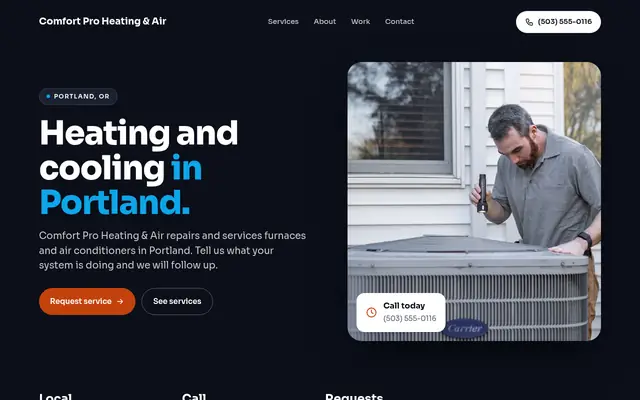
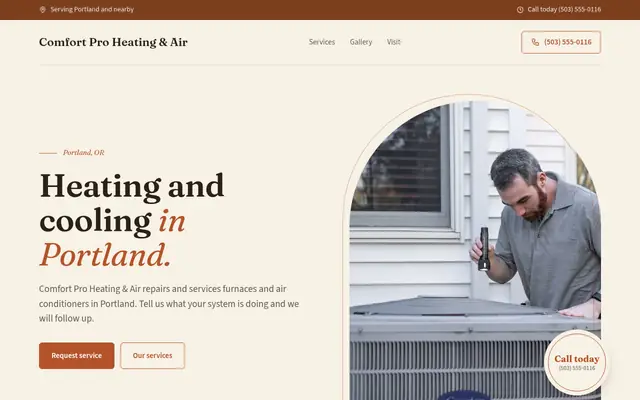

Sample sites for a fictional business. Yours uses your own name, services, hours and photos.
Pricing
Starter
A clean one-page site, live today.
- 1-page website
- Hosting and SSL included
- yourname.sitebee.co or your own domain
- Edit text, photos and hours anytime
- Email support
Pro
A full site that brings in leads.
- Everything in Starter
- Opening logo reveal
- Multi-page site (up to 6 pages)
- Standard .com included (up to $15/yr value)
- Contact and booking form
- Google Maps embed
- Basic analytics
Max
We keep you showing up on Google.
- Everything in Pro
- Opening logo reveal
- SEO setup: Google Business Profile, schema, sitemap
- Monthly local SEO tune-ups
- Priority edits, same business day
- Monthly performance report
Pro gives repair, replacement and maintenance their own sections and adds a request form that captures the problem and the address. No setup fee, cancel any time.
HVAC Contractors: common questions
What should an HVAC website lead with?
Your phone number, the area you serve, and the three things people need: repair, replacement and maintenance.
Should I mention financing?
Only if you offer it. If you do, a short line near replacement services helps.
Can I post seasonal tune-up offers?
Yes. Update your headline and services from the dashboard whenever you run a seasonal special.
Do I need separate pages for heating and cooling?
It helps customers and search engines. Pro and Max give you room for both.
Can I show my license and insurance?
Yes. Add your license number and insurance details yourself. We never add claims on your behalf.